
Cleaning up broken window glass is one of those jobs that looks like five minutes with a broom and ends with a cut finger, a sliver in a bare foot or a shard found in the carpet three weeks later. The safe way is to protect yourself first, remove large pieces by hand, sweep the bulk, pick up the fine slivers with something sticky or damp, and vacuum last, while keeping children and pets out until the whole area is cleared. Taking an extra ten minutes does more to prevent injury than any amount of rushing.
This guide walks through the full process for houses, condos and small shops, with notes on what to do with glass still in the frame, what to do about carpet, and how to dispose of it.
Before you touch anything
Stop and check three things.
1. Is anyone hurt? If someone has been cut badly, deal with that first. Apply firm pressure with a clean cloth and seek medical help for deep cuts, glass embedded in skin or bleeding that does not stop.
2. Is the break the result of a break-in or vandalism? If so, report it to police and photograph the scene before cleaning up. For shop owners, see storefront window smashed overnight: what to do first.
3. Is glass still hanging in the frame? If large pieces are loose or the pane is cracked and could fall, do not work underneath it. Leave removal to a glazier, or arrange a temporary board-up. Our guide to boarding up a window safely explains the options.
If you are not sure, keep the room closed and call for help.
What you need
You probably already own most of this.
| Item | Why you need it |
|---|---|
| — | — |
| Cut-resistant or thick leather gloves | Protects hands when picking up pieces |
| Safety glasses | Protects eyes from flying fragments |
| Closed, sturdy shoes | Stops slivers going through soles |
| Long sleeves and trousers | Protects arms and legs |
| Stiff broom and dustpan | For the bulk of the glass |
| Cardboard box or thick container | To collect and dispose of glass safely |
| Damp paper towels or a damp cloth | To catch fine slivers |
| Duct tape or wide packing tape | To lift tiny fragments from surfaces |
| Vacuum cleaner with a hose attachment | To finish the job, ideally a shop vacuum |
| Flashlight | To see slivers that catch the light |
| Marker | To label the box |
Do not use bare hands, and avoid using a household vacuum with a bag you would struggle to empty safely.
Step-by-step: cleaning up broken glass indoors
1. Clear the area
Move people and pets out of the room. Close the door if you can. Pets walk through glass and then lick their paws, which is a real hazard. Keep children away until the entire job is finished and you have double-checked the floor.
2. Suit up
Put on shoes, gloves, glasses and long sleeves. If the glass is fine, such as from tempered glass that has crumbled into small pieces, a dust mask can help if the work raises dust.
3. Pick up the large pieces
Start with the largest fragments. Pick them up carefully by hand and place them in the cardboard box. Do not toss them into a thin plastic bag, because they will cut through it. Work from the outside of the area toward the middle to avoid pushing glass around.
4. Look overhead and around
Check the window frame and nearby surfaces for fragments that could drop. Look on sills, furniture, curtains and shelves. Shake curtains outdoors, if you can, rather than indoors.
5. Sweep the bulk
Use a stiff broom and dustpan to collect the small pieces. Sweep gently and slowly, in one direction, to avoid scattering glass. Empty the dustpan into the cardboard box, not a regular trash can.
6. Pick up the fine slivers
This is the step people skip. Press a damp paper towel or cloth onto the floor to pick up fine slivers that the broom missed. On hard floors, you can also use a wide strip of tape, sticky side down, pressed along the surface. Some people use a slice of bread, which works for a few slivers but is messy. Whatever you choose, work in sections and discard the used material into the box.
7. Use the flashlight
Hold a flashlight at a low angle across the floor. Glass shows up as tiny sparkles. Check under furniture and along baseboards.
8. Vacuum last
Vacuum the area with a hose attachment, going slowly and covering the whole floor, as well as cracks and corners. Do not use a vacuum on large pieces, because they can damage it. After vacuuming, empty the container outdoors and wrap any sharp debris in paper. If you use a bagged vacuum, replace the bag after the job and put the old one into the box.
9. Wipe and check
Wipe the area with a damp cloth. Walk around in shoes first, then check again with the flashlight. Only when the area is clean should you let people and pets back in.
What about carpet and rugs?
Carpet traps glass, and it is easy to miss. A careful process helps.
1. Pick up all visible pieces by hand with gloves.
2. Press a lint roller or wide tape on the surface to lift small shards.
3. Vacuum slowly in several directions.
4. Repeat the tape and vacuum passes.
5. For heavily affected rugs, consider professional cleaning or replacement.
Keep people in shoes in the room for some time, and check the area regularly for any slivers that rise to the surface over the next few weeks. In severe cases, such as a shattered tempered window over a thick carpet, it may be easier to cut out and replace a section of carpet.
Cleaning up glass outdoors
If the glass has fallen outside, on grass, soil or a patio, the process is similar but needs extra care.
- On hard surfaces, sweep and then use a damp cloth or a magnet-free tool to pick up fine pieces.
- On grass or soil, rake gently with a leaf rake and then use a flashlight to check. Glass hidden in grass is a risk for children, pets and lawn mowers.
- On gravel or mulch, careful hand-picking of obvious pieces is the main option. Consider covering the area temporarily.
- In planters and garden beds, wear thick gloves and remove debris by hand.
After a storm or break-in, check the area around the window for pieces thrown further than you expect.
Broken glass still in the frame
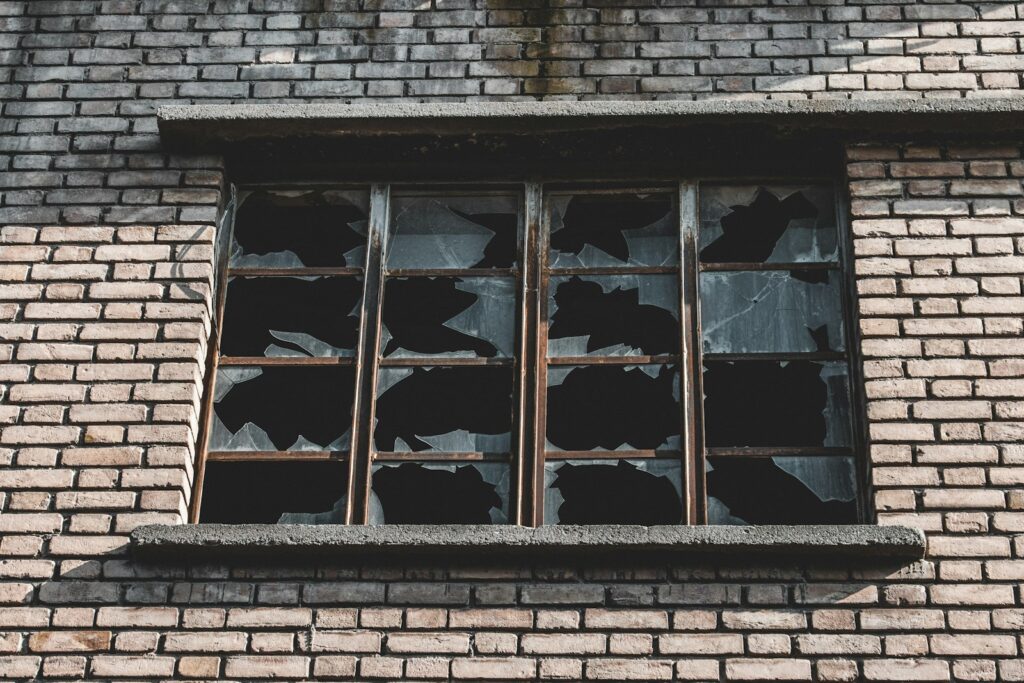
If glass is still held in the window or door frame, treat it as more dangerous than the glass on the floor.
- Do not push or tap loose pieces. They can fall without warning.
- Do not stand directly under a cracked pane that is above you.
- Place tape across the glass to hold fragments in place, only as a short-term measure.
- Call a glazier to remove it safely and board up or replace the opening.
Our 24/7 emergency board-up service handles this kind of job day and night. For types of breaks and what they mean, read cracked vs shattered glass: repair or replace.
How to dispose of broken window glass
Broken window glass is not the same as bottle and jar glass, and it generally does not go in the recycling container. Practices differ between municipalities, so check your local waste guidelines. The usual approach for small quantities is:
1. Place the glass in a sturdy cardboard box or a thick container.
2. Seal it with tape.
3. Label it clearly, for example "Broken glass, handle with care".
4. Put it in your regular garbage, if your municipality allows it.
For large amounts of glass, such as a whole window or patio door, ask your glazier whether they will remove and dispose of it. Many do, and it is often safer than carrying large sharp pieces yourself. Do not leave broken glass in an open container near a gate or on the curb where waste collectors or passers-by could be hurt.
First aid for glass cuts
Glass injuries are common during cleanup. A few simple steps help.
- For small cuts: wash with clean water, apply gentle pressure with a clean cloth, and cover with a bandage.
- For bleeding that does not stop, deep cuts, or cuts in sensitive areas, apply firm pressure and seek medical help.
- If glass is embedded in the skin, do not dig it out. Cover the area and get medical help.
- If you suspect glass in an eye, do not rub. Cover it loosely and seek urgent medical care.
- For slivers in feet, use tweezers if the piece is visible and removable, and see a medical professional if it is deep or you cannot find it.
Check your tetanus status if you have a deep or dirty wound, and talk to a health professional if you are unsure.
Common mistakes
- Using bare hands or sandals
- Sweeping before picking up large pieces
- Using a regular trash bag
- Skipping the damp towel or tape step
- Letting pets or children in too soon
- Vacuuming over large shards
- Ignoring the window frame and sill
- Forgetting to check the area the next day with a flashlight
- Dumping glass into recycling
Special cases
Tempered glass
Tempered glass breaks into small pebble-like pieces that spread over a wide area. Expect to find them in places far from the window. Take extra time with the vacuum and the tape.
Laminated glass
Laminated glass holds together, so you may need to cut or lever it out in sheets. This is a job for a glazier, because the pieces are heavy and the edges are sharp.
Mirrors
Broken mirrors produce many sharp fragments that reflect light, so a flashlight helps. Treat them as you would window glass.
Sealed double-pane units
These may contain two panes, with the outer or inner broken. Be careful of both layers, and keep an eye out for fragments between the panes.
Glass broken right now? 24/7 Glass Ltd answers around the clock across Metro Vancouver. Call (604) 401-4351 or send us your details and we will tell you what to do next.
After the clean-up
Once the glass is gone, the opening still needs protection. A temporary board-up keeps out weather and intruders, and a glazier can measure and order the replacement. If the damage came from a storm, an accident or a break-in, take photos before you clean, keep receipts and talk to your insurer. Our guide on whether home insurance covers broken windows explains what to document.
A short checklist
- Shoes, gloves and eye protection on
- People and pets out of the room
- Large pieces by hand into a cardboard box
- Sweep the bulk
- Damp towel or tape for slivers
- Flashlight check
- Vacuum last
- Seal, label and dispose of the box properly
- Board up or replace the window
If the job feels bigger than you expected, such as a large patio door that has shattered or a window with glass still in the frame, it is completely reasonable to call a professional. It is faster, safer and usually less stressful than doing it alone.
Frequently asked questions
What is the safest way to clean up broken window glass?
Wear gloves, safety glasses and sturdy shoes. Pick up large pieces by hand into a cardboard box, sweep the bulk, lift fine slivers with a damp paper towel or tape, then vacuum last. Keep children and pets out until the area is fully checked.
How do I find tiny glass slivers on the floor?
Hold a flashlight at a low angle across the floor so the slivers sparkle. Press a damp paper towel or wide tape on the surface to pick them up, then vacuum slowly and check again the next day.
Can I put broken window glass in the recycling?
Usually not. Window glass is different from bottles and jars and generally does not go in curbside recycling. Wrap it in a sealed, labelled cardboard box and check your municipality’s rules, or ask your glazier to dispose of large pieces.
Is it safe to remove glass left in the window frame myself?
It is safer to leave it to a professional. Loose or cracked glass in the frame can fall without warning and cause serious cuts. A glazier can remove it safely and board up the opening until replacement.
What should I do if I cut myself on broken glass?
Wash small cuts, apply gentle pressure with a clean cloth and bandage them. For deep cuts, bleeding that will not stop or glass embedded in skin or an eye, apply pressure if appropriate and seek medical help promptly.